 In Front of the
In five lines
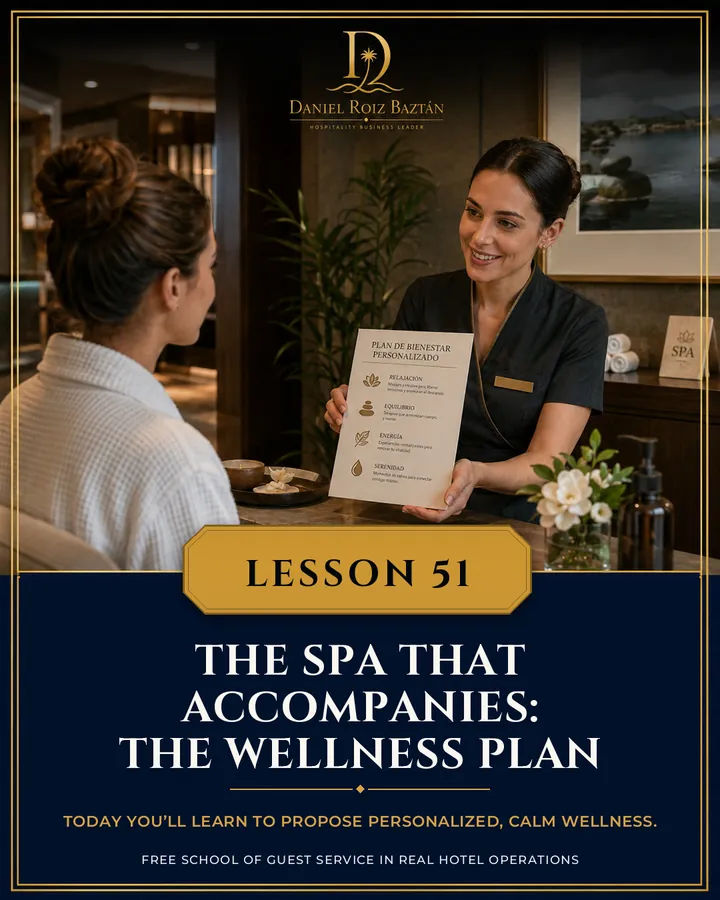
Lesson 35 taught you the calm sale of a single session; this one teaches you to think in wellness plans, not in one-off treatments. The first visit lets you listen to what the guest is looking for, provide the service within the scope of the professional qualification and, at the close, propose prudent continuity if it truly adds value. Without diagnosing medical conditions, attributing clinical causes or promising therapeutic results: the plan comes from a professional assessment within the remit of the role, never from the catalog.
The script, step by step
- 1The first visit begins by listening. The question from lesson 34 (“How are you feeling? What do you need from this session?”) is completed at the end with a prudent assessment of the experience: what sensations the guest reports, what service was performed and which wellness option might fit. If pain, an injury or a warning sign appears, you don’t diagnose: you stop and refer the guest according to the protocol.
- 2Continuity with a why they can understand. Explain what wellness goal another session would have and what they can reasonably expect, without clinical language or guarantees: “If you found it beneficial, we can repeat an adapted session during your stay and see how you’re feeling.” The guest understands the proposal without receiving a diagnosis that is not the spa’s to give.
- 3The honest complementary treatment. “This massage pairs with [this other treatment], which completes it: one works the muscle, the other settles and reduces inflammation. Together, it’s a different experience.” Only if the pairing is real — the catalog complementary treatment that complements nothing is the cross-selling that destroys the trust you have earned.
- 4The stay plan. If you know they leave on Sunday, you can offer them a reasonable schedule, leaving room to assess how they feel between sessions. Guiding the stay is service; the spa billing more is the consequence — in that order, always. You never promise they will walk out “like new.”
- 5The door open for their return. When you say goodbye, provide only authorized wellness guidelines within your remit. If the guest accepts the continuity, record the minimum information in the approved system, with restricted access and in accordance with the privacy protocol. Loyalty is sown by remembering well, not by writing everything down.
With limited resources: how to hold the standard
In front of the guest
Recommend within your qualifications, with clear prices, prudent expectations and a flexible schedule. Record only what is necessary in the authorized system.
Propose the house’s standard plan to everyone alike. Use the appointment book as pressure (“I’m getting booked up, make up your mind”).
Invent or exaggerate a problem to sell continuity (“this is in really bad shape”) — fear is not a sales tool, and in wellness it is the ultimate betrayal. Promise results that don’t depend on you.
Common mistakes
- Closing the first session without a map: the guest who leaves without knowing what their body needs has once again received just a massage — not a spa service.
- The plan that sounds like a bundle deal: if the proposal starts with the package price and not with the need the guest expressed, you have already lost.
- Recommending continuity without making it easy: a plan with no appointment offered on the spot (“Shall I book you for Thursday?”) is an intention, not a plan.
- Forgetting the authorized record on the second visit: making them repeat information they have already shared destroys the promised continuity; consulting it without need violates their privacy.
“The plan comes from a careful professional assessment,
never from the catalog.”
A first-time guest who reports neck tension; a seven-night stay, arrived on Monday. Write your close of the first session word for word: an assessment within your remit, a proposal of continuity without clinical promises, a possible complementary treatment, a flexible schedule and a goodbye that leaves the door open for their return. In the answer that follows, I share mine.
The Spa That Accompanies: The Wellness Plan
My close for that first session, word for word: “How do you feel? [answer] I’m glad. During the session you mentioned tension in your neck area, and we worked within the treatment you chose. If you found it beneficial, we can consider another tailored session on Thursday and see then how you are feeling. If the pain persists or increases, the right thing to do is to consult a healthcare professional about it. If that works for you, reception will find you a slot — no obligation.”
Look at the pieces: it starts with the guest’s own perception, explains prudently what service was performed, proposes continuity without clinical language or guarantees and makes clear when a referral is appropriate. The schedule adapts to their stay, but also to how things develop and to their decision. Prices are stated naturally when the details are confirmed.
And the spa’s memory is managed just like the hotel’s: only the minimum necessary information, in the authorized system, with restricted access and in line with the privacy protocol. Remembering well doesn’t mean writing everything down.