 In Front of the
In five lines
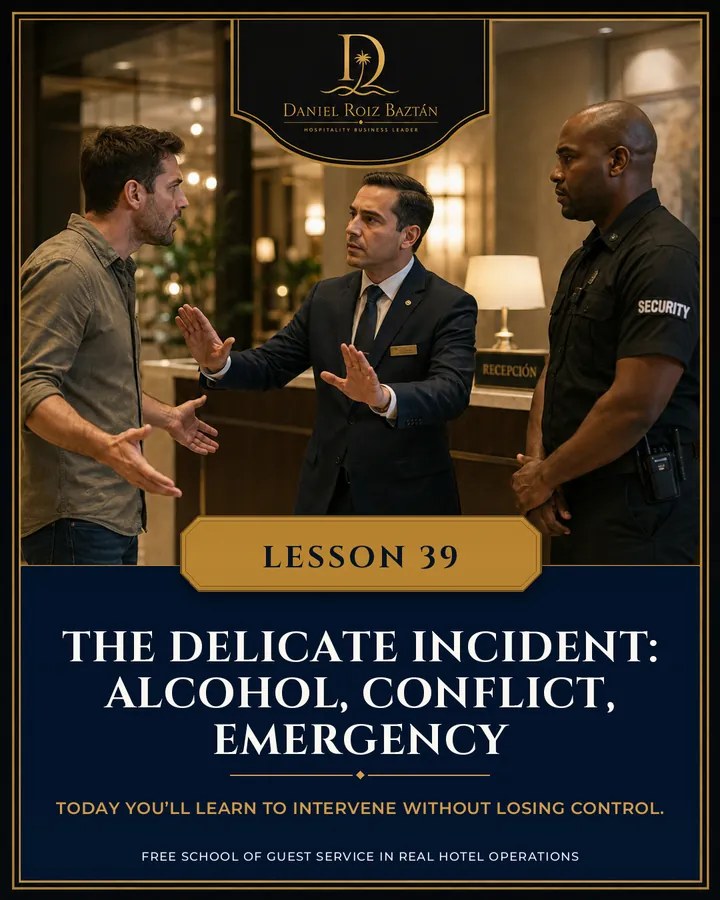
Sooner or later it comes: the guest who has had too much to drink and is bothering others, the argument that escalates, the real emergency. In those minutes, the whole hotel’s peace of mind rides on how a single person acts — and the professional response has an order that is not improvised: de-escalate first (the low voice, the space, the dignified way out), contain next (protect others, isolate the situation, ask for support) and always record. The rule that governs it all: the goal is never to win the incident — it is for it to end with the least possible harm to everyone, including the person at its center.
The script, step by step
- 1De-escalate with your voice and with space. A voice lower than theirs (volume is contagious in both directions), a respectful distance, their name if you know it, and the dignified way out up front: “let’s talk it over here, where it’s calmer.” Most incidents are defused when someone stops climbing the ladder.
- 2Protect the scene. If there is an audience — and in a hotel there always is — the priority is to separate: invite the person to a space apart, put distance between them and other guests, ask a colleague to look after those affected. An incident without an audience loses half its fuel.
- 3Contain without touching and ask for support early. Physical contact is the last resort and only to protect against imminent harm — never to impose. And support is requested before you desperately need it: raising the alert in time isn’t weakness; it is the difference between an incident and a serious incident. If the situation is beyond what the hotel can handle, the appropriate emergency services or authorities are called without hesitation.
- 4Close with a record and with care. Once the moment has passed: a report in the authorized channel — time, objective facts, only the strictly necessary data of those involved, action taken; access restricted to whoever needs it, retention in line with the protocol and secure deletion when the period expires — and the human close — the affected guests looked after, the team that lived through it supported and the information passed to management so consequences can be decided with a cool head. What was handled well and recorded can always be defended.
With limited resources: how to hold the standard
In front of the guest
Low voice, a dignified way out, separate from the audience, look after those affected, record everything.
Argue the substance with someone who is in no state to reason. Threaten consequences that aren’t yours to decide.
Humiliate or expose the person in front of an audience — making a public example of someone creates an enemy of the hotel. Touch anyone except to protect against imminent harm. And never look the other way at a sign of violence toward someone vulnerable: that is always acted on and reported.
Common mistakes
- Answering volume with volume: you’ve just doubled the incident.
- Handling it alone out of pride: whoever didn’t raise the alert in time turned their courage into problem number two.
- Forgetting the collateral victims: the family at the next table also needs a couple of sentences and a small courtesy.
- Not recording it “because in the end nothing happened”: it did happen — and the record of what almost happened is next month’s prevention manual.
“First calm, then control,
always the record.”
Midnight: a guest who has had too much to drink raises their voice at the bar and starts bothering another table. Write your complete sequence of action — approach, phrases, handling the audience, support, close and record. In the answer that follows, I share my version.
The Delicate Incident: Alcohol, Conflict, Emergency
My sequence. First, remove the fuel: the audience. I approach within his field of vision — never from behind — speaking quietly, using his name if the bartender gives it to me: “Mr. Torres, would you come with me for a moment? Let me offer you something more relaxed, just next door.” Getting him off the stage is half of the de-escalation: without spectators, almost nobody needs to win.
Second, the conversation away from others: a calm tone, zero lecturing (“you’ve had a lot to drink” only inflames things), dignified options — “I’ll walk you to your room” or “I’ll get you something to eat somewhere quiet.” The bartender, coordinated with a glance, has already cut off alcohol service gracefully (lesson 24: quietly and with an alternative). If he accepts any of the dignified ways out, we all win and tomorrow nothing will have happened — and that is success, exactly that: that tomorrow he has breakfast without embarrassment and without a complaint.
And if it escalates: the minimum containment necessary, never alone, an immediate alert through the channel to the person in charge — and to medical assistance or the authorities if there is real risk — and never an avoidable struggle or a hand-to-hand fight out of pride. Third, always, calm or not: the record in the authorized channel — time, objective facts, the strictly necessary data, action taken; with access restricted on a need-to-know basis, a retention period documented in the protocol and secure deletion when it expires. A well-recorded incident protects the guest, the hotel and, above all, you. What wasn’t written down, someone else will write tomorrow — their own way.