 In Front of the
In five lines
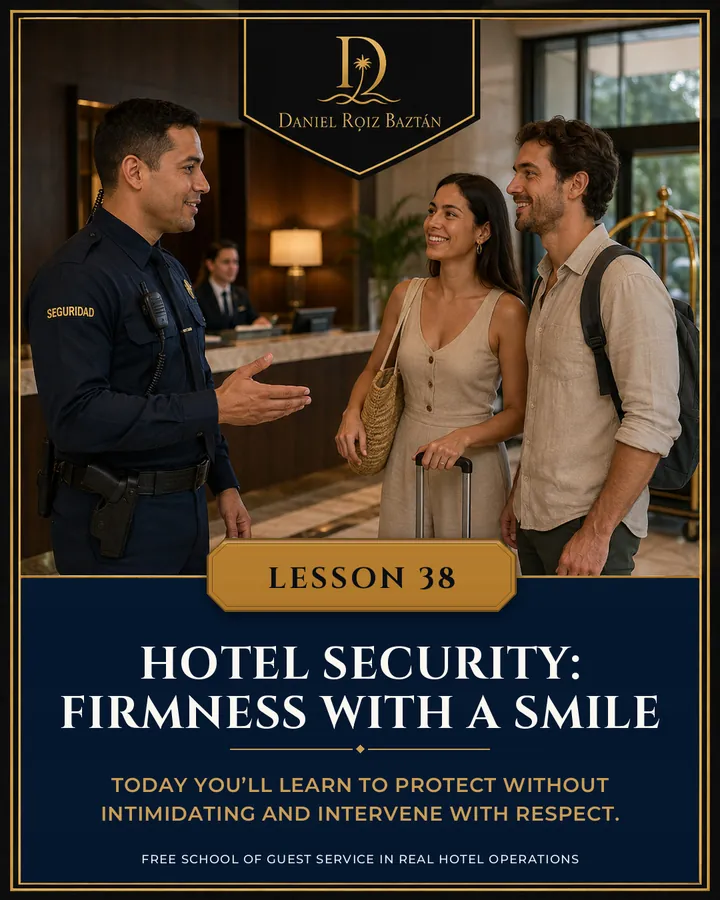
The hotel security officer works inside a paradox: their presence must deter whoever comes to do harm and, at the same time, welcome whoever comes to rest — in the same uniform and in the same second. That’s why hotel security is unlike any other: its main tool is not force but friendly observation, the greeting that takes note, the presence that reassures some precisely because it makes others uncomfortable. A good hotel security officer is, above all, a host with trained eyes.
The script, step by step
- 1The greeting that observes. Every “good morning” of yours does two jobs: hospitality toward the guest and silent verification of observable circumstances — are they registered? Where are they heading? Does their behavior call for help or directions? Courtesy is your best control tool: for the guest it is a welcome; for the intruder, a warning that they have been seen.
- 2The friendly interception. When behavior doesn’t fit — coming in without registering, a long wait with no apparent purpose, heading toward a restricted area — the first approach is always one of service: “Good afternoon, may I help you? Who are you visiting?” Said with a smile, it resolves 95% of cases without friction: it guides the legitimate visitor and deters the rest — without having accused anyone.
- 3Discretion as a uniform. Security matters are handled in a low voice, without an audience and without a show: the hotel sells peace of mind, and nothing breaks it like seeing security in dramatic action. Effective firmness is the kind almost nobody notices.
- 4A record of everything. Every incident, check or oddity is entered in the authorized report: time, place, an objective description of the facts and the action taken — with no unnecessary personal data and no judgments about people; it is consulted by whoever needs it and kept according to the hotel’s protocol. The security report is the hotel’s protective memory — and your professional backing if one day what happened has to be reconstructed.
With limited resources: how to hold the standard
In front of the guest
Greet everyone: the greeting is hospitality and verification at the same time. Intercept by asking how you can help. Handle things in a low voice and without an audience.
Look at a guest with visible suspicion because of their appearance: a profile is not a criterion — behavior is. Turn a check into an interrogation.
Touch anyone except when strictly necessary for protection. Humiliate the person you intercept in public: security that shames creates the very conflict it was meant to prevent.
Common mistakes
- Confusing presence with intimidation: the security officer with crossed arms and a fixed frown makes the guest more uncomfortable than the intruder.
- Easing off observation during quiet hours: incidents choose precisely the hours when nobody is watching.
- Trusting the shift’s memory to your head: what isn’t recorded didn’t happen — and what didn’t happen protects no one.
- Acting out of territorial pride: your job isn’t to win the situation — it’s to make sure the situation never comes to exist.
“The best security is the kind that says hello.”
Someone unidentified crosses the lobby toward the elevators with a determined stride, without looking at anyone. Write your complete interception: how you approach, your exact first sentence, what you do if they respond well — and what you do if they respond badly. In the answer that follows, I share my version.
Hotel Security: Firmness With a Smile
My interception, word for word: I step forward to meet them naturally — not as a barrier, but as a host — and then the secret weapon of the craft: the helpful greeting. “Good afternoon — can I help you? Are you heading to the front desk, or can I point you somewhere?” Notice the move: I haven’t accused them of anything, I haven’t asked them for anything, and yet they have already stopped, they are looking at me and they have to say what they are there for. A friendly greeting is an access control that offends nobody.
The answer resolves 95% of cases: the real guest answers normally (“I’m going to my room, 320”) and you send them off with a “have a good rest” — looked after, not policed; the legitimate visitor is accompanied to the front desk (“they’ll announce you right away”); and the one who hesitates, dodges or speeds up has just told you everything you needed to know — then, yes, a firm escort toward the front desk and a report through the channel, without making a scene.
The rule that sums up the module: in a hotel, security that is noticed attacks the experience, and security that doesn’t exist puts it at risk. The exact point is this: the honest guest feels a friendly hotel and the intruder feels an impossible hotel — with the same sentence.