 In Front of the
In five lines
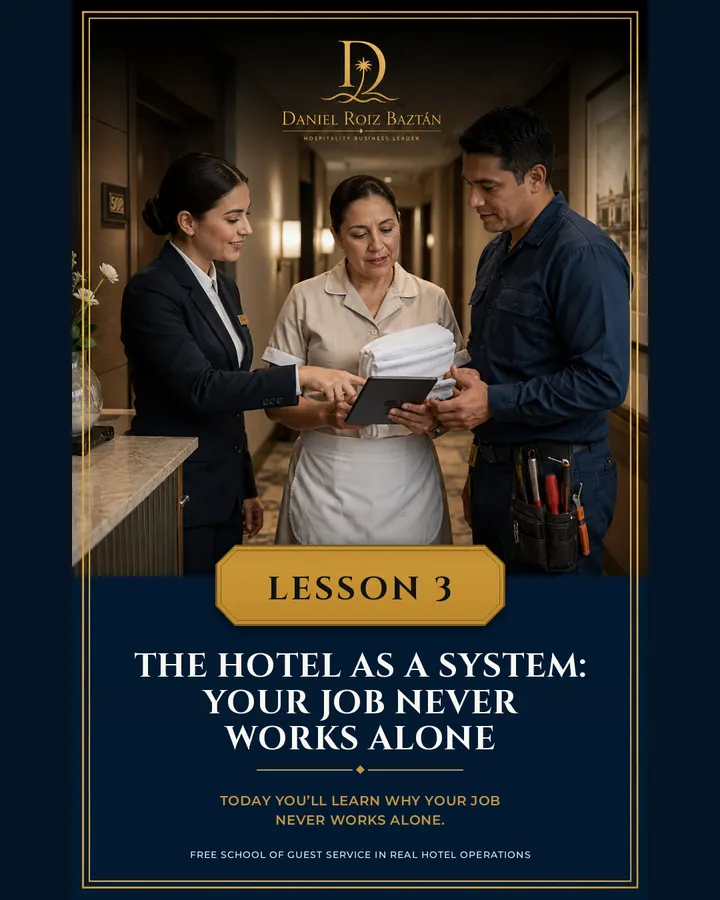
The guest believes their room, their breakfast and the air-conditioning repair are independent services. They never are. The room is ready on time because the Front Office, Housekeeping and Maintenance share the same version of reality; breakfast works because the Kitchen, the Restaurant and Purchasing talked yesterday. Understanding this changes your professional category: you stop being someone who does their task and become someone who holds up a system. And in front of the guest, the system has an iron rule: among ourselves, we speak plainly and put things right; in front of the guest, we are one.
The invisible chain, with a real example
- 1The promise: the Front Office tells a family that their room will be ready at 3:00 p.m. For the guest it is a sentence; for the hotel it is an internal contract between four departments.
- 2The chain: Housekeeping needs to know that room is a priority; Maintenance must close the air-conditioning work order today; the Laundry has to deliver the linen on time; the Front Office must give notice if the family arrives early.
- 3The broken link: if one of the four doesn’t share its information — doesn’t give notice, doesn’t report, doesn’t ask — the guest waits in the lobby with two tired children. And it won’t be “Housekeeping” or “Maintenance” that failed them: the whole hotel will have failed them.
- 4Your part: in any job, your work has internal suppliers and internal customers. Knowing who they are, what they need from you and when is as much part of the craft as your visible task.
In front of the guest: how the system speaks
Answer for the whole hotel: “I’ll take care of it” or “Let me put you through right now to the person who can” — and check that it was resolved.
“That’s not my job” / “that’s another department.” For the guest, departments don’t exist: the hotel does.
Blame a colleague or another department in front of the guest. Whoever points at someone else is pointing at their own uniform.
Common mistakes
- Keeping information to yourself “because nobody asked”: in a hotel, silence is a breakdown.
- Promising on behalf of another department without checking: the promise is yours; the failure is the hotel’s.
- Fixing the symptom and keeping quiet about the cause: if room 214 breaks down every week, repairing it is no longer enough; reporting it is.
- Believing coordination is a job for the bosses: the system rests on the handovers, the reports and the warnings from the frontline.
“Among ourselves, we speak plainly and put things right.
In front of the guest, we are one.”
Choose your job — the one you have or the one you want — and draw its chain: the three departments without which your work fails, exactly what you need from each and what they need from you. You’ll be surprised by what you discover in the third column. In the answer that follows, I share my version — and we begin Module 1: Front Office.
The third column
I asked you for your job’s chain: three departments, what you need and what they need from you. The third column is the one that matters, and I’ll tell you why.
Anyone knows the first column. Whoever has been there a year knows the second. But the third — what others need FROM YOU — almost nobody has ever thought about, because nobody teaches us to see ourselves as suppliers. The room attendant is a supplier to the Front Office; the technician, to the room attendant; the cook, to the restaurant team. As soon as you see yourself that way, you stop “finishing your task” and start “delivering your work” — and delivering includes giving notice, reporting and asking.
Keep that chain: in every module of this season you’ll see it working from the inside. The next one begins with the link that faces the guest: the Front Office.
“School taught you the procedure. The craft begins when there is a person in front of you.”
“Service doesn’t begin when the guest sees you. It begins when you decide, at your locker, who is going to walk out that door.”
“Magic isn’t doing something extraordinary. It’s doing the ordinary as if that person were extraordinary.”
“Among ourselves, we speak plainly and put things right. In front of the guest, we are one.”
End of the Introductory Module. The next part continues with Module 1: Front Office — where the hotel shows its face.