 In Front of the
In five lines
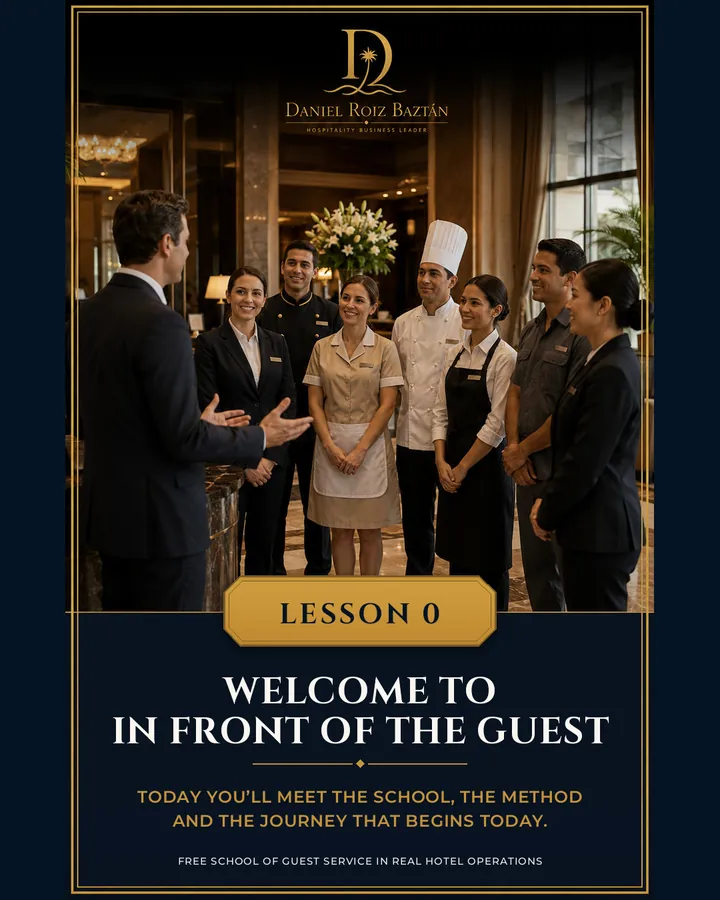
This school exists because of a border no other school teaches: the one that separates knowing your trade from practicing it in front of a person who complains, enjoys, waits or hesitates. At school you learned the procedure; here you will learn where the magic happens and where it is lost. I am Daniel Roiz Baztán, a hotel general manager, and I am going to tell you what I demand — and what I reward — when someone on my team is in front of a guest. One micro-lesson at a time, an exercise to think through in each one, and my reasoned answer right after it. Free, with no advertising and no commercial purpose. Just the craft.
How the school works
- 1One lesson at a time, at your own pace. Each one is a micro-lesson you can study on the website or download as a PDF to save, print or forward — and its answer comes right after it.
- 2Every lesson ends with an exercise. You don’t send it to me: you think it through, and if you’re one of the good ones, you write it down. Paper puts in order what the head takes for granted.
- 3In the answer that follows, I tell you how I would solve it, reasoning the way a general manager reasons: diagnosis, decision, communication. There is no textbook answer; there is judgment.
- 4When you have completed all fifty-four lessons, download the compact study book as a single PDF — every lesson and answer gathered in its sixteen modules — review it, and take the final exam that leads to the Certificate of Achievement.
In front of the guest: this school’s code
Each departmental lesson will include this table adapted to its job. Today, the universal version — valid for any uniform in the hotel:
Look, greet and use the name. Announce what you are about to do. Do what you say, and give your own name when you say goodbye.
Talk to colleagues about your own affairs in front of the guest. Recite technical jargon. Complain about the hotel or the shift where you can be heard.
Lie to a guest. Humiliate others or let yourself be humiliated. Touch what isn’t yours. Tell outside what you saw inside.
The first rule, before all others
You will often work without all the resources you would like: product, spare parts, time, hands. This school will not ask you for the impossible; it will teach you the right order of thinking when resources fall short. And that order starts with a sentence we will repeat until it is yours: the standard is not negotiable; the means adapt. With a limit we will also repeat: no means is ever adapted at the expense of safety, legality or anyone’s dignity. A guest can forgive running out of something. They won’t forgive finding no one there.
“School taught you the procedure. The craft begins
when there is a person in front of you.”
Write in one sentence — just one — why you want to do this work. Keep it somewhere it won’t get lost: we will come back to it in lesson 48, and you will know whether it is still true. In the answer that follows, I share what I would answer.
Your why — and mine
I asked you for a sentence: why you want to do this work. Let me tell you what I’ve learned from reading thousands of similar answers in job interviews.
Sentences that begin with “I like” usually last two seasons: the liking runs out in the first tough high season. Those that begin with “I want to become” last longer, but they break if the promotion is slow to come. The ones that truly sustain a career almost always talk about another person: “because I love seeing the guest’s face when…,” “because at home, welcoming people was sacred.”
If your sentence talks only about you, that’s not wrong — but keep an eye on it. If it talks about someone else, keep it safe: that’s the fuel that never runs out.
Mine: because the most beautiful thing about this profession is becoming part of the beautiful memories of the people who visit us. Over the years I came to understand that so is training and developing the people you work with. See you in lesson 48 to check whether ours are still true.