 In Front of the
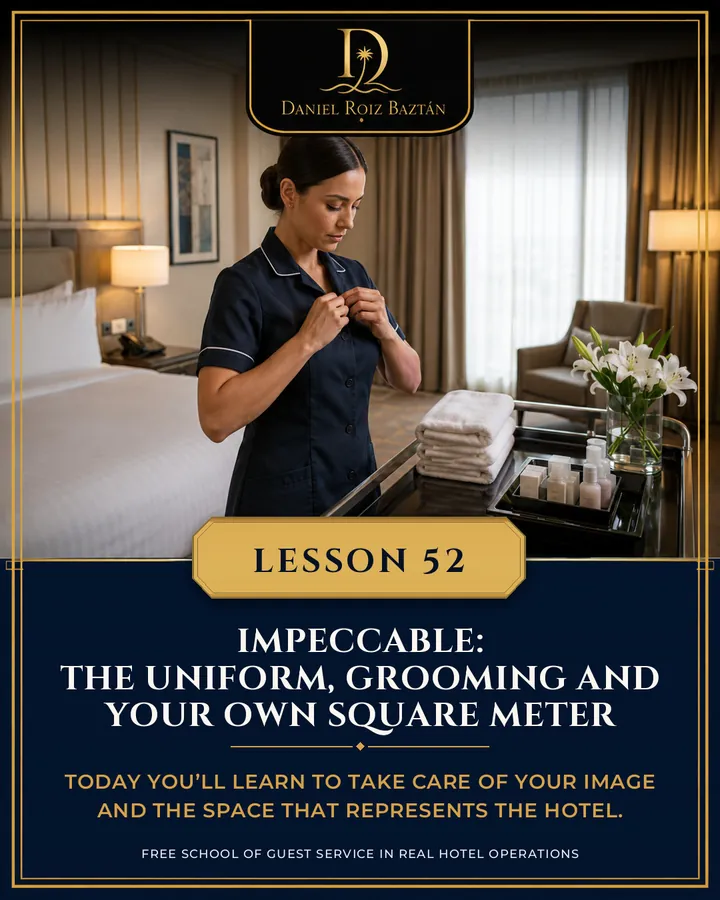
In five lines
There is a sale that happens before any word: the one made by your uniform, your personal grooming and the state of your workstation. The guest reads them in two seconds and deduces everything else from them — quality of service, level of detail, exquisite cleanliness, the class of the house. It is the cheapest and most powerful message a hotel can send, and every employee sends it, on every shift, whether they know it or not. The visible hygiene of the kitchen (lesson 26), the invisible detail of luxury (lesson 18) and the impeccable uniform at four in the morning (lesson 9) are chapters of this same law: neatness is not aesthetics — it is information. This lesson turns it into daily discipline.
The script, step by step
- 1The uniform as a contract. Clean, pressed, complete and with your name badge on: the uniform says “there is a standard here” before you say “good morning.” And remember the law of lesson 26: the humble garment kept impeccable communicates more class than the expensive one neglected. Neatness isn’t bought — it is practiced.
- 2Personal grooming: where the guest looks. Hands and nails first of all — they are what the guest looks at in whoever serves them a plate, hands them a key or shakes their hand. Then: hair well kept or tied back, clean-shaven or a well-groomed beard, a neutral scent (neither tobacco nor overpowering perfume: the leading scent is the hotel’s, not yours) and your breath kept in check. The mirror before you go in is the last professional gesture before the guest.
- 3Your square meter is a showcase. The counter clear, the tray gleaming, the cart tidy, the side table clean, the service pantry that can’t be seen but can be sensed: the guest deduces the kitchen they can’t see from the counter they can. Your tidy workstation is the visible proof of all the hotel’s invisible standards.
- 4Neatness works a continuous shift. The uniform at nine in the morning must be the uniform at eleven at night: a micro-check at every break, the stain dealt with on the spot or the garment changed, the counter cleared between one guest and the next. Impeccability that slackens by mid-afternoon wasn’t a standard: it was posing for the opening.
- 5Understand the message you send. All of this tells the guest one single thing: “here, detail is looked after.” And their deduction is automatic and inevitable: if this is how they look after what I see, think how they’ll look after my room, my food, my safety. Neatness is the visible guarantee of everything the guest cannot inspect.
With limited resources: how to hold the standard
In front of the guest
Check yourself before you go in and keep it up throughout the shift. Leave your workstation impeccable for the handover: whoever relieves you inherits your showcase (lesson 44).
Primp, adjust your uniform or check your reflection in surfaces in front of the guest. Eat, drink or chew at your workstation. Lean on the counter as if the shift were weighing on you.
Show up with an unchecked uniform or careless grooming “because it’s quiet today”: today’s guest doesn’t know how many guests there are — they only see you. And never handle the guest’s food or textiles with hands that have just touched something else: neatness is also a sequence.
Common mistakes
- Believing neatness is for the boss: it is for the guest — the boss is only the second one to notice it.
- The “I’ll change it later”: between the stain and the later, there are forty guests reading the wrong message.
- The perfect workstation only when there’s an inspection: an intermittent standard is theater, and the 4:40 p.m. guest pays the same as the one during the general manager’s visit.
- Perfume as a substitute: neatness smells clean, not of cologne. What is masked gets noticed — and it shows that it is being masked.
“Before your first word, your appearance has already said welcome —
or already apologized.”
Run the mirror-and-square-meter audit on yourself: write down ten points a demanding guest would look at today — five about you (hands, shoes, uniform, hair, name badge) and five about your workstation. Score yourself from 1 to 10 on each, honestly. The two worst get fixed first thing tomorrow. In the answer that follows, I share what I look at when I walk through a hotel.
Impeccable: The Uniform, Grooming and Your Own Square Meter
Let me tell you what I look at when I walk through a hotel — the real order of my gaze, which is also that of the demanding guest. First, the shoes: they are the item nobody thinks gets looked at and the one we all look at; a clean shoe with a veteran uniform says craft, a dirty shoe with a new uniform says costume. Second, the hands and nails of whoever is serving me: they are going to touch my key, my glass, my plate — they are the hotel’s hygiene in portable form. Third, the name badge and the overall look: complete and straight, or half-done and sagging. And fourth, the desk or the station: if its square meter is impeccable in mid-afternoon — not at nine in the morning, which is easy — that hotel has a real standard.
Notice that all four are gestures of professional habit — the touch-up, the name badge, the mutual check, the square meter — and that none of them replaces what is the company’s responsibility: enough uniforms, footwear where applicable, replacement, cleaning or compensation, and work equipment, in accordance with the applicable regulations and collective agreement. Appearance rules, moreover, must be objective, proportionate, justified by hygiene or safety, non-discriminatory and respectful of privacy. With the proper means on the table, this test does reveal something: the habits of the teams. That’s why it’s the first diagnosis I make when I arrive at a new hotel: tell me what your uniforms look like at five in the afternoon — and how the house provides them — and I’ll tell you the state of your entire operation.
If in your audit the two worst points were about your workstation and not about you, take note: it is the most common result and the most revealing — we look after what we wear and neglect what surrounds us, and the guest sees it all together, as a single message. Tomorrow, those two points. And next, we close the season on a high note.