 In Front of the
In five lines
The menu is the document every guest receives in the same way; the recommendation is the layer only you can add — and it is the one that turns a dinner into an experience and a check into a result. It works with the same mechanism you learned at check-in in lesson 5: you know what the guest cannot know — what is at its best today, the off-menu wine, the finishing touch at dessert — and offering it to them with its description and its extra cost made clear is a service, not a sale. What decides everything is the moment you say it and the truth with which you say it. This lesson gives you the exact timing.
The script, step by step
- 1MOMENT 1 — When you hand over the menu: opening with the day’s specials. Before they dive into it: “Before you look at the menu, let me tell you: today we have [this and this], which are at their best right now.” Two or three, not seven; told with appetite, not recited. You have just given them information the menu doesn’t have — from that instant on, you are their advisor, not their server.
- 2MOMENT 2 — At the order: the off-menu wine. Once the dishes are chosen, the targeted recommendation: “And if you’ll allow me a recommendation, to go with this we have an off-menu wine — [twenty-second story: winery, grape, why it’s special] — for just [X] extra. It’s a little gem.” The short story makes it desirable; the clear price makes it honest. Without both pieces there is no recommendation: there is an ambush or there is a mystery.
- 3MOMENT 3 — When you serve dessert: the finishing touch. Never with the check — when you serve dessert: “Would you like a glass of champagne with it? It rounds off the meal.” You already know from lesson 8 that the last impression is the one that turns the stay into a memory: the finishing touch at dessert is its table version.
- 4Once, with elegance. Each offer is made once, and the no is accepted with the same smile as the yes. The guest who declines today and didn’t feel pushed is the one who asks tomorrow, “What do you recommend?” — and that guest is already yours.
- 5The truth as the limit. You only recommend what is truly at its best, and you only tell the story that is true. The day the fish didn’t arrive as it should have, that day you don’t recommend the fish. Your credibility is the most expensive inventory to restock.
With limited resources: how to hold the standard
In front of the guest
Tell the recommendation with a brief story and a clear extra cost, looking them in the eye. Accept the no with the same smile as the yes.
Recite the same soulless “today we have” at all twenty tables. Systematically push the most expensive item. Insist after a no.
Invent a wine’s story or its origin: a lie uncovered at the table invalidates all your future recommendations. Hide the extra cost and let it show up on the check: it is the small betrayal from lesson 8, in its expensive version.
Common mistakes
- Offering the champagne with the check: the finishing touch is served with dessert; after that it is no longer a finishing touch, it’s a charge.
- The three-minute story: twenty seconds seduce; three minutes hijack the table.
- Recommending without knowing: “everything is very good” is the absence of a recommendation (lesson 23) — and the off-menu demands that you know it better than the menu.
- Measuring success only by the check: the declined recommendation that left a good taste also sold — it sold your credibility for tomorrow.
“Selling is serving
when what you offer makes their evening better.”
Write your complete script for the three moments for a real dinner in your restaurant: your opening with the day’s specials (two dishes), your off-menu wine with its twenty-second story and its extra cost, and your finishing touch at dessert. Word for word. In the answer that follows, I share mine.
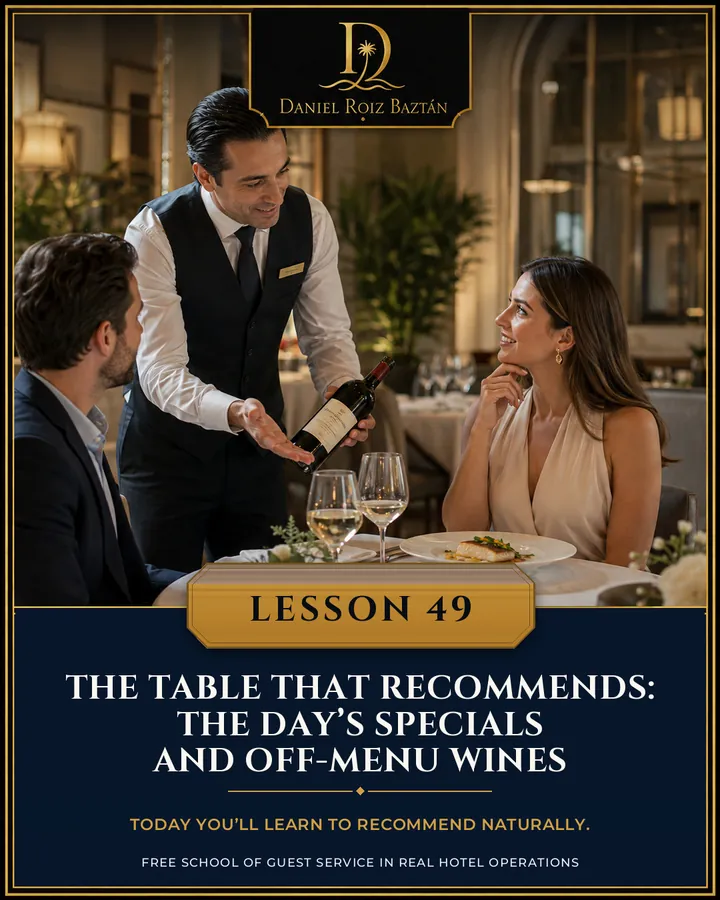
The Table That Recommends: The Day’s Specials and Off-Menu Wines
Here is my script — notice where the difference lies. The opening: “Before you look at the menu, let me tell you about today: this morning we got in a fish straight from the fish market that we’re cooking over the coals, and the rice dish we only make on weekends. I’ll let you take your time.” Two things, told with relish, and then you step away — the opening sows; it doesn’t reap.
The wine, when taking the order: “For that fish, if I may, I have something off the menu: a white from a small winery in [region], barely three thousand bottles a year — we brought it in because we fell in love with it. The bottle is [X] more than the one on the menu. I think you’re going to love it.” Count the seconds: twenty. A story (small, human, true), a match with THEIR dish and the price said naturally. And the finishing touch, with dessert on the table — never with the check: “Shall we pair it with a glass of champagne? It’s the ending this dessert is asking for.”
The two mistakes I read most often in this exercise: the story that turns into a lecture (at forty seconds the wine no longer matters; what matters is that you stop talking) and the whispered or hidden supplement — which turns your gem into an ambush. The rule of lesson 5, applied to the dining room: telling them what you offer AND what it costs is exactly what turns it into service.