 In Front of the
In five lines
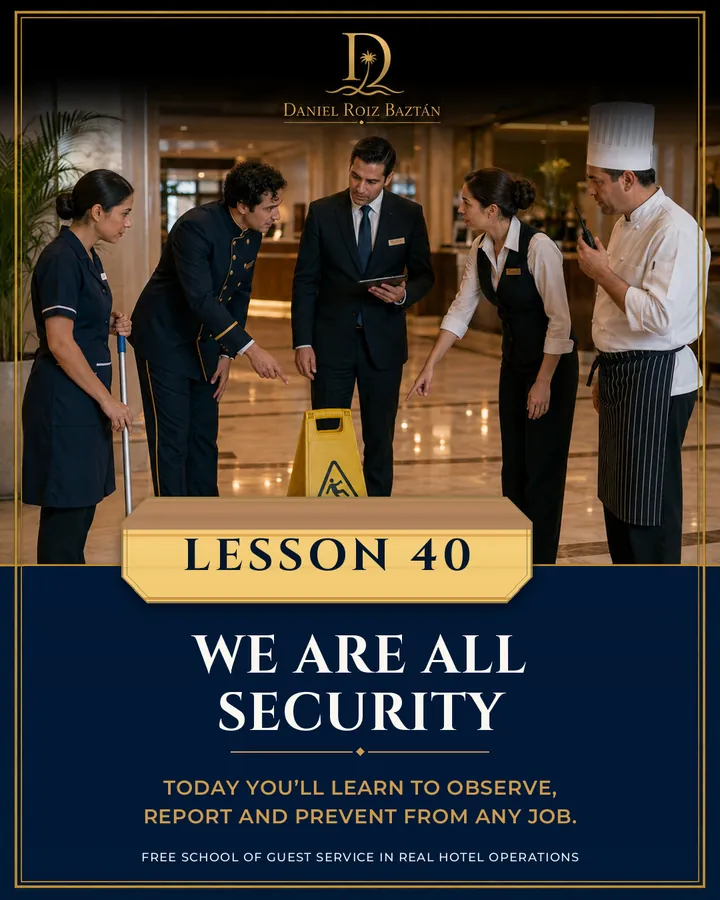
A hotel’s security isn’t made by one department: it is made by the sum of all the eyes that work in it. The room attendant sees the door that doesn’t close; the server, the child who has been alone for too long; the technician, the smell of burning; the front desk agent, the long wait of someone who isn’t heading toward anyone or anywhere. None of them is a security officer — and all four are security. The system works with a three-verb formula that closes this school’s departmental modules: see (the eye trained on what doesn’t fit), report (through the channel, in time, with facts) and don’t be the hero (your job is to trigger the response, not to star in it).
The script, step by step
- 1Train your job’s eye. Every position sees things no other position sees: make your list of the five risk signals your job can detect before anyone else — the blocked emergency exit, the abandoned object, smoke, the forced door, the behavior that doesn’t fit, the child alone. What isn’t on your list, you won’t see when it happens.
- 2When in doubt, report it. A weak signal is reported even if it’s probably nothing — because the cost of the two mistakes is asymmetrical: an unnecessary alert costs a minute; a silence when the alert was needed can cost everything. “I didn’t want to bother anyone” is the phrase that comes before every avoidable serious incident.
- 3Report it well: channel, facts, calm. To whoever it concerns (Security, the shift leader, the front desk), with the precise what-where-when, and without alarming the public: an emergency is communicated with the same discretion with which it is managed. An alert that spreads panic creates the second problem.
- 4Your role ends where the risk begins. Contain the immediate problem if it is safe to do so — shutting off a valve, moving a guest out of the way, putting up warning signs — and leave the intervention to whoever is responsible for it. The employee who triggers the response properly saved the situation just as much as the one who carries it out: the whole chain is the hero.
With limited resources: how to hold the standard
In front of the guest
Keep your job’s eye active while you do your work. Report discreetly and with facts. Reassure the guest if they ask, without claiming a control that hasn’t been confirmed: “we are handling it; please follow the team’s instructions” — and “it’s resolved” only when it truly is.
Discuss the signal with colleagues instead of reporting it. Voice alarms in front of guests.
Ignore a signal that affects a vulnerable person — a minor, someone disoriented, someone in danger: that is always acted on and reported, without exception and without weighing up whether “it’s really something.”
Common mistakes
- Believing that keeping watch is someone else’s job: the uniform you wear includes the eyes.
- Normalizing the repeated oddity (“that one’s always hanging around”): what gets normalized stops being seen — you’ll remember it from lesson 33, and here it protects people.
- Reporting late for fear of looking foolish: in security, looking foolish is the best possible outcome of an alert.
- Turning the alert into a chat session: the signal travels through the channel, not through the service pantry.
“See, report —
and don’t be the hero.”
Make your job’s list: the five risk signals your position can detect before the Security department — and for each one, whom you would report it to and in exactly what words. In the answer that follows, I share my list — and we begin Module 12: The Difficult Guest.
We Are All Security
Here are the five that, in my experience, have saved the most lives in hotels, each one owned by a different job. The room attendant: the room door that doesn’t close properly — nobody else in the hotel will touch it today; if she doesn’t report it, it will spend the night open. The breakfast server: the small child alone near water or stairs — each parent thinks the child is with the other; whoever sees it stays with the child and raises the alert. The technician: the smell of electrical burning or the breaker that trips — their nose gets there weeks before the smoke. The night front desk agent: loitering — the person who comes in and goes nowhere, the car circling the parking lot. And the entertainment host: the swimmer in difficulty or dangerous exhaustion at the pool — an entertainment host’s attention has prevented more drownings than many life buoys.
Notice the pattern: Security can’t see any of the five in time, because Security doesn’t live in your square meter. You do.
And the second half of the rule, as important as the first: see and REPORT — don’t go it alone on what is too big for you. The hero who tackles an electrical panel alone or wades in to break up a fight adds one more victim to the incident. The channel exists so that your eye counts without your body paying for it. With this, you wrap up Security: the whole hotel has just gained forty pairs of eyes.
“The best security is the kind that says hello.”
“First calm, then control, always the record.”
“See, report — and don’t be the hero.”
End of the module. The next part continues with Module 12: The Difficult Guest.