 In Front of the
In five lines
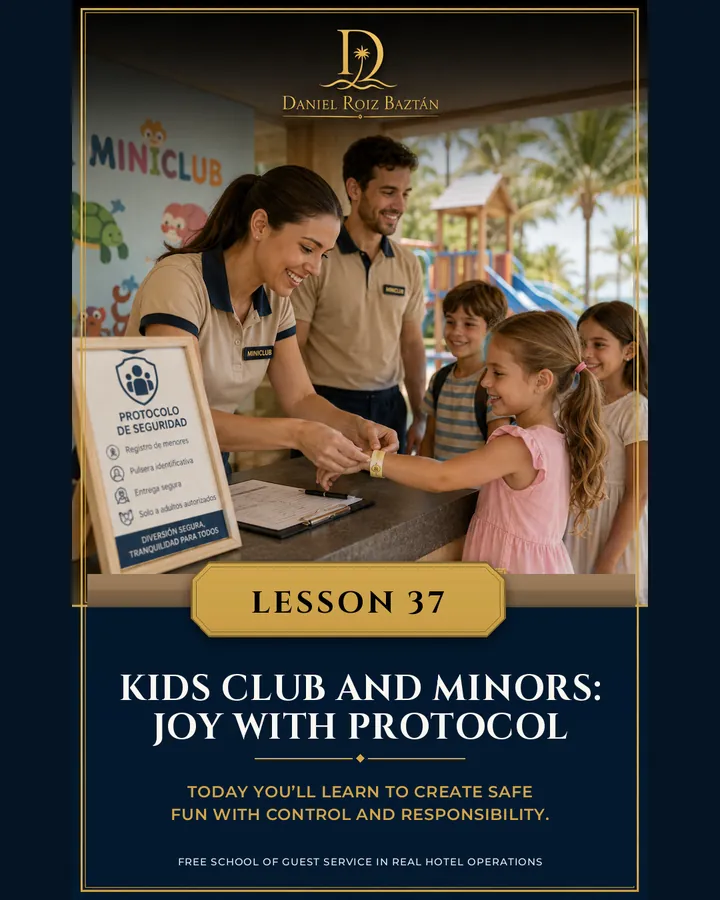
The kids club is the only place in the hotel where parents hand over the most valuable thing they have — and that handover turns fun into a custody system. Here the protocol doesn’t accompany play: it makes it possible. Documented registration and handover, constant visibility, respected ratios and an absolute golden rule about who picks up whom. The brilliant kids club host isn’t the one who knows the most games: it’s the one a mother looks in the eye and decides, without hesitation, that she can leave with peace of mind. That look is earned with order — and lost with a single lapse.
The script, step by step
- 1Registration is the border. Every child comes in with a registration form: who they are, who brings them, who is authorized to pick them up, allergies and needs, the parents’ immediate contact details. Without a complete form there is no entry — with all the kindness in the world and without a single exception. And the form exists only for the child’s safety: it is kept under lock and key or in the authorized system, only whoever is looking after the child consults it, and it is securely disposed of when the purpose that justified it ends.
- 2Handover only to whoever is on record. The child is handed over exclusively to the adult registered on the form or authorized in writing on it — by verifying, not by recognizing them by sight. If anything changes (“his uncle is coming to pick him up”), you contact whoever registered the child before handing them over. The awkwardness of verifying lasts a minute; its absence can last a lifetime.
- 3Constant visibility. Spaces open to view, doors that stay open, activities where everyone sees everyone — and the professional rule that protects children and the team alike: no adult alone with a minor, ever. Bathroom trips are accompanied by staff in pairs, or the parents are notified; the rule allows no shortcuts because of haste.
- 4Ratios and the headcount. Every host knows how many children they are responsible for and counts them — at every change of activity, space and shift. Counting out loud isn’t mistrust: it’s the heartbeat of the kids club. And every incident, however minor it seems (a fall, a long bout of crying, a scuffle between children), is recorded and reported to the parents at pickup.
With limited resources: how to hold the standard
In front of the guest
Greet every child by name and every parent with the registration form at the ready. Count out loud. At pickup, report how everything went.
Relax registration with returning children (“I already know them”): the protocol protects precisely because it makes no distinctions.
Hand a child over to an adult who is neither registered nor authorized, whoever they are and however convincing they seem — you always verify with whoever registered the child. No adult alone with a minor. And no photos of children on personal phones, ever.
Common mistakes
- Mistaking the protocol for off-putting red tape: well explained (“it’s for everyone’s safety”), it is the kids club’s best selling point.
- The mental headcount “because there are only a few”: custody incidents almost always happen with few children and too much confidence.
- Not reporting a minor incident “so as not to worry them”: the parent who finds out from their child and not from you loses all their trust.
- Forgetting that the child is a guest too: they are listened to, respected and never ridiculed — children are the audience that never forgets a slight or a kindness.
“A family’s trust is earned with order,
not just with games.”
An adult who says he is the father — and who is neither the person who registered the child nor on record as authorized — wants to take the child “to the pool for a moment.” He is friendly, in a hurry, and the child seems to know him. Write exactly what you do, word for word, from start to finish. In the answer that follows, I share my version — and we begin Module 11: Security.
Kids Club and Minors: Joy With Protocol
My course of action, and in this lesson there are no shades of gray: friendly in form, unbending in substance. “Happy to help — it’s for everyone’s safety: I can only hand children over to the person who registered them or to someone listed as authorized. Would you come with me for a second so we can sort it out? We’ll call [the person who registered the child] right now and in a minute you’ll be at the pool with him.” Full smile, full protocol. The child does not leave the area in the meantime — and another kids club host keeps the group looked after: checking on one can never leave ten without eyes on them.
If the verification confirms it (the person who registered the child authorizes it then and there or comes over), the release is logged with the time and that’s it — complete normality, zero drama. If it can’t be confirmed or the adult gets overly uncomfortable, the child stays, the person in charge at the hotel is notified and a record is made. An adult’s discomfort for two minutes weighs nothing against the safety of a minor. Nothing.
And notice the argument that defuses 99% of the annoyance: “it’s for everyone’s safety — we would do exactly the same with your child.” The real father, when he hears it, isn’t offended: he’s pleased. He has just confirmed that his child is in the one place in the hotel where nobody can take them away. That sentence is the most important sales minute of the kids club — and of the whole hotel.
“Joy is also served à la carte.”
“A family’s trust is earned with order, not just with games.”
End of the module. The next part continues with Module 11: Security.