 In Front of the
In five lines
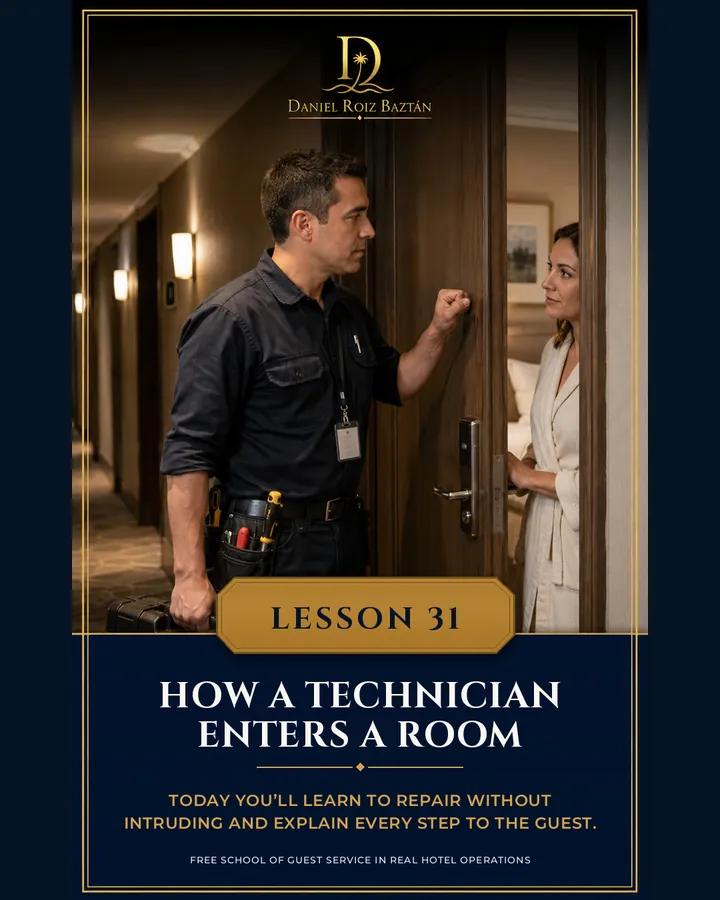
Nobody has to teach a maintenance technician their specialty: that’s what their craft is for. What nobody taught them is what that specialty becomes when it happens in a stranger’s private space, sometimes with that person right there. The entry protocol you learned in lesson 11 applies in full — knock twice announcing yourself, really wait, open with a pause — and on top of it comes the technician’s own layer: the protected area, the tidy tools, the explanation of what is going to be done and absolute respect for what isn’t yours. In there, you fix two things: the breakdown and the trust.
The script, step by step
- 1The door protocol, in full. “Maintenance, good morning” — twice, in a clear voice, with a real wait and an announced, unhurried opening. The urgency of a work order can’t cost anyone a fright. If there are signs someone is inside and they aren’t expecting you, you coordinate and come back.
- 2Introduce yourself and explain before you touch anything. If the guest is there or arrives: who you are, what you’ve come for, roughly how long you’ll take. “I’m here to check the air conditioning; it’ll take about twenty minutes — is now a good time, or would you rather I came back?” Their comfort outranks your route, always.
- 3Protect the scene. A drop cloth or protective cover under the work area, tools kept tidy in their box or on a cloth — never spread out on the guest’s bed or furniture — and footwear and hands aware of where they are. The area is left better than it was found: no debris, no marks, no trace.
- 4Their belongings: untouchable. If something of the guest’s gets in the way of your work, you ask them to move it if they are there; if they aren’t, you move only what is essential and put it back in its exact place. And what you saw in there — tidiness, mess, belongings, people — doesn’t exist outside: the discretion of lesson 20 wears coveralls too.
- 5A close with a face. When you finish: what was done, what is still pending if anything, and a goodbye with your name. “Your air conditioning is working now; I’m [name], from Maintenance — if you need anything, the front desk can reach me in a minute.” A technician with a name turns a nuisance into a service.
With limited resources: how to hold the standard
In front of the guest
Announce yourself, ask permission, explain what you’ll do and how long it will take, protect the area, say goodbye with your name and leave everything better than you found it.
Comment on the state of the hotel (“everything here is old”), diagnose catastrophes out loud, use the guest’s bathroom or furniture, take personal calls inside.
Touch belongings more than is strictly necessary. Stay alone with a minor in the room: if a child is there alone, you report it and come back accompanied. Tell outside what you saw inside. Promise what doesn’t depend on you.
Common mistakes
- Going in “because the work order says so”: the work order calls for the repair; the protocol governs the entry.
- Working with the guest present as if they weren’t there: a greeting and one sentence of context turn an intrusion into attention.
- Leaving the technician’s signature — the mark on the wall, the plastic on the floor, the moved chair: a perfect job that leaves a trace is a job half done.
- Fixing it and not reporting its real condition: if the part will last a week, someone has to know today — silence is a breakdown (lesson 3).
“In that room your craft is twofold:
the repair and the trust.”
You’re doing a repair with the guest present, and they want to stay and watch and make conversation while you work. Write how you handle the situation: what conversation you accept, which you redirect kindly, what you never comment on — and how you close. In the answer that follows, I share my version.
How a Technician Enters a Room
My answer: the guest who watches is not a nuisance — they are an opportunity with conditions. You welcome them naturally (“of course, stay — I’ll talk you through it”), you explain what you’re doing in plain language (curiosity that is attended to builds trust) and you use it for the fine diagnosis: nobody knows that room’s symptoms better than the person who sleeps in it. “How long has it been making that noise? Only at night?” — the guest is your best work order.
What you handle with tact: the conversation can’t make the repair take twice as long or distract you from the delicate part. The formula is attention in bursts — you work, you comment, you work — and if the chat gets out of hand, the friendly close: “let me finish this in five minutes and it’ll be perfect.”
And what you never do: give opinions about the hotel or the state of the installation (“everything here is old” is sabotaging your own house), diagnose catastrophes out loud, accept tips to “take a quick look at something else” outside the work order without logging it, or let closeness lower the protocol: their belongings remain untouchable even when the guest is right there inviting you to be at ease. The guest’s friendliness doesn’t replace your method — it should ring a bell from lesson 11, and in maintenance it counts double.