 In Front of the
In five lines
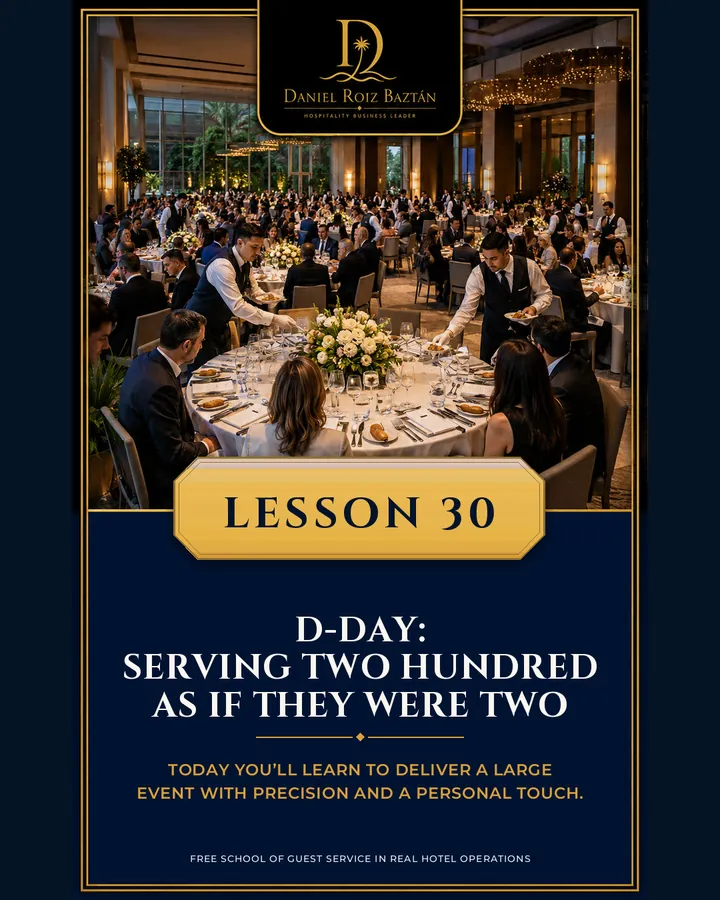
The banquet is the operation’s trial by fire: two hundred people, one menu, a kitchen at its limit and a host whose memory of their most important day is on the line. The paradox of the craft is that volume demands industrial method and the occasion demands handcrafted service — and both at once are achieved with three tools: synchronization (the pass in waves, the dining room coordinated by a single voice), reading the room (the event sets the pace, not the kitchen) and the client within the client: the host, the person who must be freed from managing anything so they can live their own day. This lesson closes the Food and Beverage run in style.
The script, step by step
- 1A single voice runs the service. At a banquet, the dining room moves in coordinated waves: the person in charge calls the start of each course and everyone serves the whole table at once. Two hundred hot plates is a clockwork problem — and clockwork needs a single conductor.
- 2The room sets the pace. Speeches run long, the dancing starts early, the lingering after dinner stretches out: the live event outranks the timing on paper. The person in charge reads the room and renegotiates with the kitchen in real time — the worst decision at a banquet is serving the course because it was “scheduled.”
- 3The host doesn’t manage: they enjoy. A single hotel contact for the host, who anticipates their questions (“everything’s on time; the next moment is the toast at six”) and solves things before they ask. Every minute the host spends managing is a team failure — their only job today is to live their day.
- 4Critical moments, locked down. Every banquet has three or four instants that allow no mistakes: the entrance, the toast, the cake, the first dance. They are identified in the briefing, each is assigned a person in charge and during those minutes everything else can wait. The event is remembered for its moments — protect them.
With limited resources: how to hold the standard
In front of the guest
Serve each guest as if they were the only one: eye contact, care, the dish announced at the head table. Attend to individual requests within the collective machinery.
Show the effort: the rushing, the sweating and the shouted orders belong backstage — the room sees only fluidity.
Argue about an unexpected problem in front of the guests or the host. Neglect a guest “because it’s a banquet”: for every person in that room, this is their celebration too.
Common mistakes
- Serving the paper and not the room: the timing is a plan, not a law — the law is the event.
- Ten points of contact for the host: each one gives them a different version, and between them they hand the host the job of coordinating them all.
- Relaxing after the main course: the banquet is scored as a whole, and the cold coffee at the end of the meal is the last impression of two hundred people.
- Forgetting that among the two hundred there are guests from the previous lessons: the allergic guest, the child, the one who needs help — volume doesn’t suspend a single rule of this school.
“The perfect banquet is the one the host
never had to manage.”
The bride moves her speech forty minutes earlier and the second course is half served. Write down your complete handling: what the dining-room manager decides, what is negotiated with the kitchen, what the host is told and how the waves are reorganized — without the room noticing a thing. In the answer that follows, I share my version — and with it we close the Food and Beverage and Events modules: Module 8 begins, Maintenance in Front of the Guest.
D-Day: Serving Two Hundred as if They Were Two
My handling, with the clock running. The floor manager decides, in ten seconds, the only question that matters: what rules, the plate or the moment? And in a banquet the answer is always the same: the moment. The bride’s speech is one of the day’s locked-down moments — the plate can wait; her speech with the room half served and servers crossing in front, cannot.
The execution: the pass frozen with one clean order to the kitchen — “Holding all waves: speech moved up; I’ll call the restart” — and the kitchen protects what’s already plated so it can be brought back to temperature without loss (that’s why banquet menus are designed with dishes that can take a pause: flexibility is cooked before the event). The floor team quietly completes the half-served tables or discreetly clears whatever would spoil the photo, and everyone takes up critical-moment positions: still, attentive, invisible.
And the single point of contact does the fine work: you don’t tell the bride “wait, we’re halfway through the course” — you tell her “Perfect, we’ll get the mic ready for you; two minutes and the whole room is yours.” Those two minutes buy the regrouping. When the applause ends, the order to resume, and the waves pick up as if nothing had happened. The room noticed nothing — and that is exactly the top grade of the craft. With this lesson you close F&B and Events: what comes next is the hotel from the inside.
“What isn’t on the sheet doesn’t exist. What is on it is a contract.”
“The perfect banquet is the one the host never had to manage.”
End of the module. The next part continues with Module 8: Maintenance in Front of the Guest.