 In Front of the
In five lines
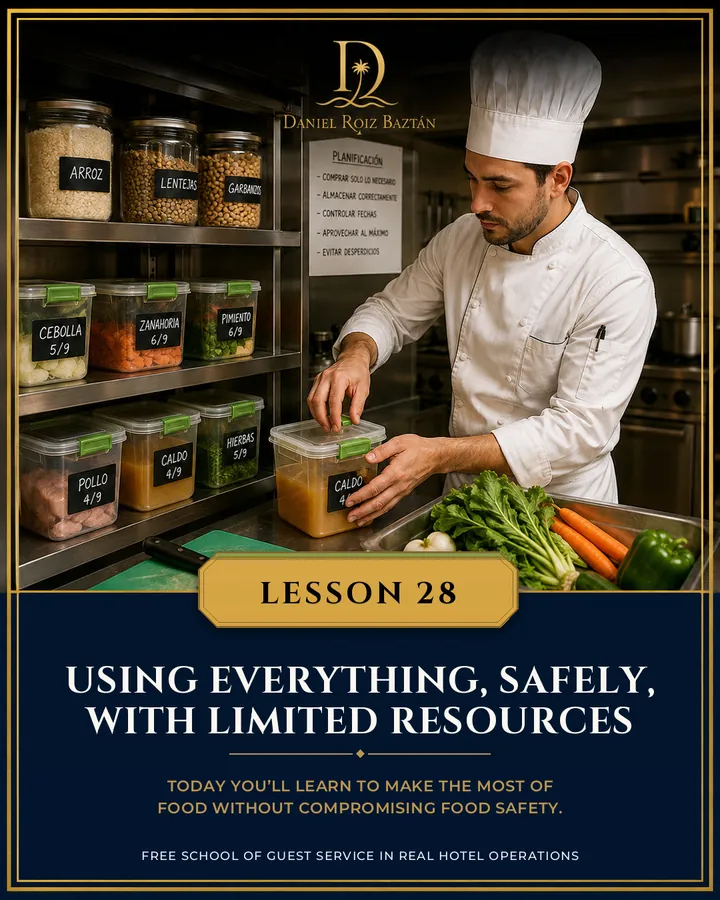
Cooking with limited resources is a double exam: of creativity and of character. Creativity lies in using everything — yields squeezed to the last, second lives for the product, substitutions that keep the level — and that is where the skilled cook shines brighter the less they have. Character lies in the red line: food safety is not adapted, not stretched and not negotiated — not for expensive product, not for a boss in a hurry, not for the walk-in that suffered a power outage. This lesson separates, with a scalpel, the territory of ingenuity from sacred territory.
The script, step by step
- 1Using everything is technique, not a quick fix. The yield of each piece planned before touching it, trimmings with a destination (stocks, forcemeats, garnishes), production adjusted to the real service history. Waste isn’t a residue: it is money and work thrown away twice.
- 2Substitution with judgment. An ingredient is missing: it is replaced by function (acidity for acidity, fat for fat, texture for texture), tasted before serving and communicated to the dining room if the dish changes noticeably — the guest can accept a change; not a surprise.
- 3The cold chain during a power outage. An ironclad protocol: cold rooms kept closed (every opening costs degrees), the time of the outage and the temperatures recorded when power returns, priority use or processing for the most sensitive products and, at the slightest doubt about any product — it is removed. The universal rule: when in doubt, it doesn’t go out.
- 4The record that protects you. Temperatures, waste, incidents and decisions are written down: the kitchen’s humble paperwork is its technical memory and its professional defense. What was decided well and recorded can always be defended; what wasn’t recorded doesn’t exist.
With limited resources: how to hold the standard
In front of the guest
If the guest sees the kitchen or asks, describe your use of everything with pride: a kitchen that doesn’t throw things away is a kitchen with craft and with values.
Carry into the dining room your stress over missing product. Justify a weak dish with the resources: the guest pays for the result, not the circumstances.
Serve product of doubtful safety, under any pressure whatsoever: not that of cost, not the boss’s, not that of a full service. That refusal is the most professional of your career.
Common mistakes
- Confusing using it up with pushing it past its limit: the product’s second life has the same standards as its first — or it doesn’t get one.
- Substituting in silence: a change not communicated to the dining room turns your solution into the server’s problem.
- Trusting the cold chain to memory: without a temperature record, all your diligence is invisible — and indefensible.
- Giving in to the pressure of “serve it, nothing will happen”: if something does happen, it happens with your signature. Whoever removes a doubtful product is never wrong.
“When in doubt,
it doesn’t go out.”
A four-hour power outage with the cold rooms full in the middle of high season. Write down your complete protocol: what you do during the outage, what you check and record when power returns, what you decide for each type of product and what you communicate — and to whom. In the answer that follows, I share my version — and we begin Module 7: Events and Banquets.
Using Everything, Safely, With Limited Resources
My protocol. During the outage: walk-ins closed and sealed off from use — every opening costs degrees, so what is needed is decided BEFORE opening, just once if it is essential. The exact time of the outage is noted, and service is organized with what is outside and safe. No heroic inventory feats in the dark.
When the power comes back: thermometer in hand and a written record — the time power was restored and the temperature of each walk-in and of the most sensitive products. With that data and the establishment’s HACCP procedure, decisions are made by category. What stayed within the established limits can continue; whatever went out of control or cannot be verified is removed. Cooking it afterwards does not automatically make a product safe when its storage cannot be proven. When in doubt, it doesn’t go out.
And communication closes the loop: to the person in charge, the complete record with the decisions made; to the floor, the dishes that aren’t available today, with an alternative presented with dignity. A technical crisis managed with method and paper isn’t something to hide in shame: it is a craft exam passed — and your record is the diploma.
“One careless gesture in plain sight undoes a hundred flawless plates.”
“During service, only the solution exists. Blame is handed out once the kitchen is cold.”
“When in doubt, it doesn’t go out.”
End of the module. The next part continues with Module 7: Events and Banquets.