 In Front of the
In five lines
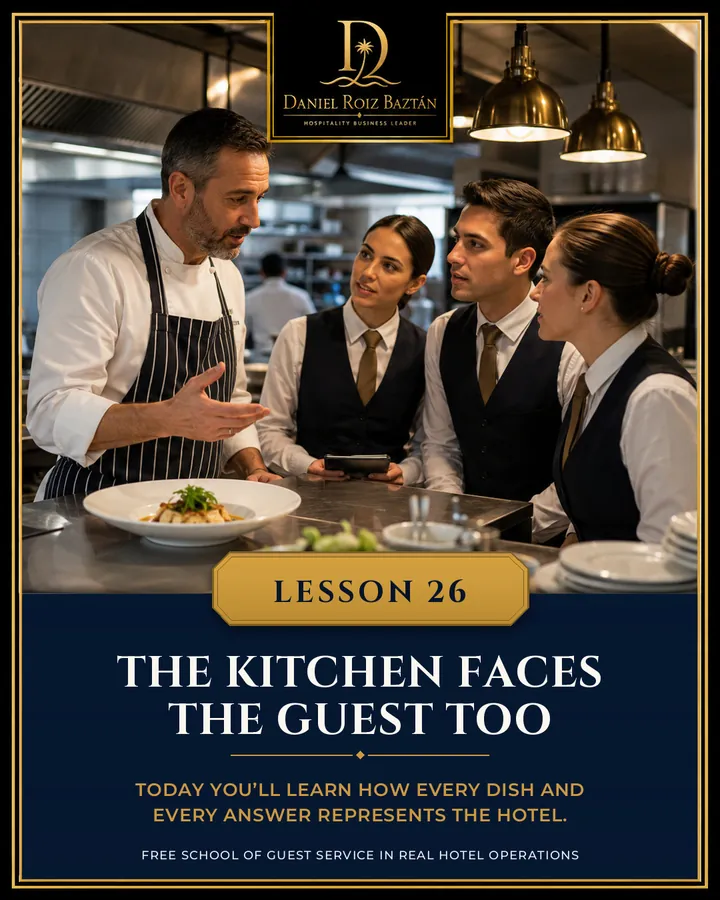
The kitchen believes it works behind closed doors, and that is less true every day: the live buffet, show cooking, the swinging door that opens, the cook who crosses the dining room. In all those seconds, the guest doesn’t evaluate your technique (they wouldn’t know how): they evaluate what they see. The uniform, the hands, the order of the line, the gesture toward a colleague, how the food is touched. Visible hygiene is the language in which the kitchen speaks to the dining room, and a single careless gesture in plain sight can undo a hundred flawless plates. This lesson brings the kitchen out onto the stage.
The script, step by step
- 1Everything visible communicates. In view of guests, a tidy line, clean cloths, a clear cutting board and the correct uniform aren’t aesthetics: they are the hygiene certificate the guest really can read. Visible disorder translates automatically into invisible doubt.
- 2Your hands are the message. Gloves or utensils where required, the habit of not touching your face or your uniform over the food, the tongs that don’t go back onto the tray after falling: the buffet guest watches the cook’s hands the way a front-seat passenger watches the speedometer.
- 3The cook facing the public is also dining-room staff. At show cooking or the live station: a greeting, eye contact, a sentence about the dish (“I’ll finish it for you in a minute; this sauce has…”). Describing the product with pride turns a portion into an experience — and it is the best brand-building there is.
- 4What never happens in view. Corrections to a colleague, shouted hurry, tasting with your finger, product on the floor even for a second. What in a closed kitchen is a bad habit is, in a visible kitchen, a review — with a photo.
With limited resources: how to hold the standard
In front of the guest
Greet the guest who is watching with your eyes. Describe the dish with pride if they ask. Keep the scene — line, hands, uniform — always ready to be seen.
Argue, correct with shouts or show annoyance in view of the dining room. Handle food with gestures you wouldn’t accept at home.
Rework a returned dish in public with bad manners or comments: the dish comes back, it is remade professionally and that’s that. And never serve anything that has touched the floor or broken the hygiene chain, however expensive the product.
Common mistakes
- Believing technique makes up for image: the guest can’t see your technique — they can only see your image.
- Relaxing the standard in the buffet’s last hour: exposure has no closing time.
- Treating the guest’s question as an interruption: it is the only chance the kitchen has to sell itself live.
- Neglecting how you cross the dining room: the cook passing through is an ambassador in a chef’s jacket — so walk like one.
“One careless gesture in plain sight
undoes a hundred flawless plates.”
List five things a guest can see on your line, buffet or station — gestures, objects, situations — that would destroy their trust in the kitchen, and for each one, the habit that prevents it. In the answer that follows, I share my list.
The Kitchen Faces the Guest Too
My list of five, the one I check on every inspection: one, the cloth — the gray rag hanging from the shoulder is a kitchen’s surrender flag; clean cloths, in their place. Two, hands to the face — the unconscious gesture of touching your face and carrying on plating; the habit is camera awareness: in sight of guests, you’re working live. Three, the dropped tongs that go back to the buffet — they’re removed and replaced, always, even if nobody is looking; precisely because someone is always looking. Four, the visible telling-off — correcting a colleague with gestures in front of the dining room; corrections belong in the back. And five, the floor — product or a box on the floor for one second; in visible hygiene, seconds don’t exist.
Notice that none of the five is culinary technique: they are the theater of trust. The guest can’t judge your stock — they judge your cloth.
And the positive flip side: the same exposure that watches you gives you a shop window. The cook who says hello, talks about the dish and works clean in plain sight is the best advertising a restaurant can buy — and it costs nothing.