 In Front of the
In five lines
There is one area of service where magic, speed and tact have no place: the guest’s safety. Allergies and intolerances, children, reduced mobility, medical or religious diets — here the craft comes down to a single verb: verify. You don’t assume, you don’t think you remember, you don’t reassure to look good. The chain is sacred: you ask precisely, you write it down, you pass it to the kitchen verbally and in writing, you confirm the dish when serving it and you carry it over to the rest of the stay. A mistake here isn’t a bad review: it can be an ambulance. This lesson has no shortcuts.
The script, step by step
- 1Ask precisely; don’t diagnose. “Do you have any allergies or intolerances we should know about?” When they answer, record exactly what the guest declares — the ingredient and whether traces could affect them — and activate the hotel’s protocol. Service staff do not determine the severity or downgrade an alert because it seems mild.
- 2Write it down and pass it on through two channels. Anything delicate travels to the kitchen in writing AND verbally — the order with the alert flagged plus a direct word with the person in charge of the pass. Never entrust an allergy to anyone’s memory, starting with your own.
- 3Verify at the pass and confirm at the table. Before serving: “is this the nut-free dish?” — to the kitchen. When serving: “your nut-free dish” — to the guest. The double confirmation closes the loop and, what’s more, it shows: the guest with special needs who feels safe is the most loyal there is.
- 4When in doubt, escalate. Don’t know whether a dish contains the allergen or whether cross-contact is possible? Check the official information and ask the designated person in charge. If the establishment cannot guarantee the preparation in line with its protocol, you tell the truth and do not present the dish as safe. Losing a sale is a ridiculous price compared with putting a person at risk.
With limited resources: how to hold the standard
In front of the guest
Always ask, always write it down, confirm when serving. Treat the special need with complete naturalness, without turning it into a spectacle.
Look annoyed at the “complicated” table. Answer from memory what requires verification. Make promises without having asked the kitchen.
Say “it’s nothing to worry about” about an allergy to avoid complications. Serve a doubtful dish trusting to luck. Hide a mistake you’ve detected: if it was served wrong, it is removed and reported immediately, with no calculating.
Common mistakes
- Confusing the protocol question with real verification: asking and not passing it on is worse than not asking — it creates false security.
- Trusting the “I’m almost sure it doesn’t have any”: in this area, almost means no.
- Not carrying the information over to the rest of the stay: the allergy mentioned at dinner must exist at tomorrow’s breakfast without the guest having to repeat it.
- Treating a religious or medical diet as a whim: for that person it is identity or health — and your respect is remembered as much as your food.
“You can play with service.
With a guest’s safety, never.”
A guest orders a dish and mentions, downplaying it, a “mild allergy” to an ingredient that dish might contain. Write down your complete course of action step by step: what you ask them, what you do with the kitchen, what you serve them and what you confirm when serving. In the answer that follows, I share my version — and we begin Module 6: Kitchen.
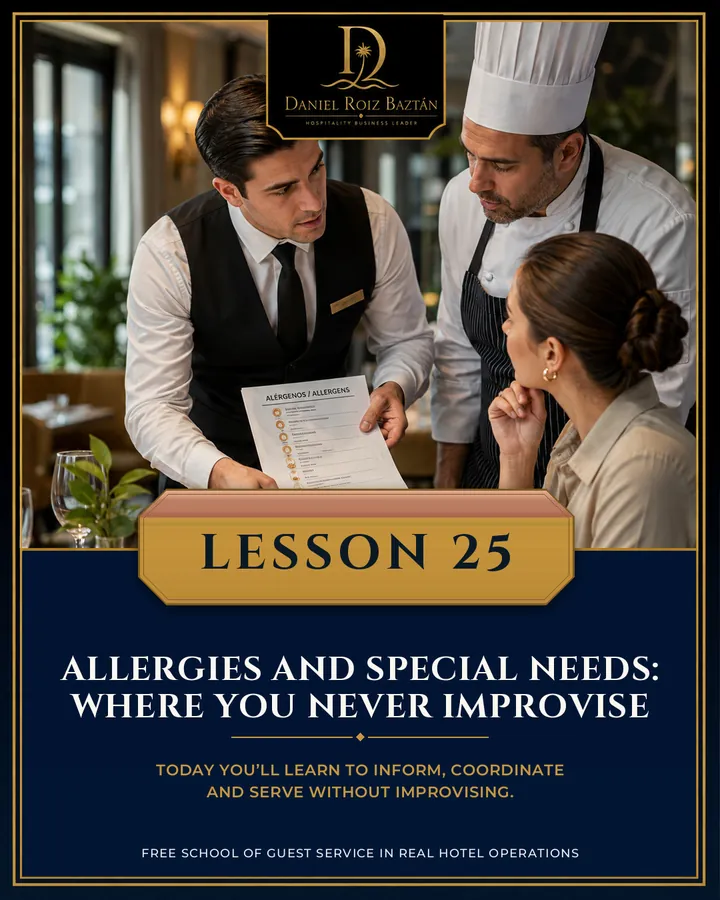
Allergies and Special Needs: Where You Never Improvise
What I do: first, precision without drama — “I’m asking seriously because it matters to me: is it an allergy or an intolerance? Do I also need to flag possible traces?” I take down exactly what the guest declares and activate the protocol; I am not the one who diagnoses the severity or decides that an allergy is mild.
Second, the truth about the dish: I don’t answer from memory. I check the official information and ask the person the Kitchen has designated as responsible. If the dish can be prepared in line with the protocol: the order flagged, a verbal alert, verification at the pass and confirmation when serving. If it can’t be guaranteed, that is said clearly, and the only alternative offered is one the Kitchen can verify; if none exists, no one invents safety.
And the close: the alert travels through the authorized channel to those who need it during the stay, with the minimum information and restricted access. The goal is for the guest not to have to repeat it, without turning health data into open information.
“An ordinary server serves plates. A professional serves people.”
“What people remember about a dinner are the touches nobody required.”
“Recommend as you would to a friend. Trust is the best average check.”
“The bar is a confessional with ice: you hear everything, you repeat nothing.”
“You can play with service. With a guest’s safety, never.”
End of the module. The next part continues with Module 6: Kitchen.