 In Front of the
In five lines
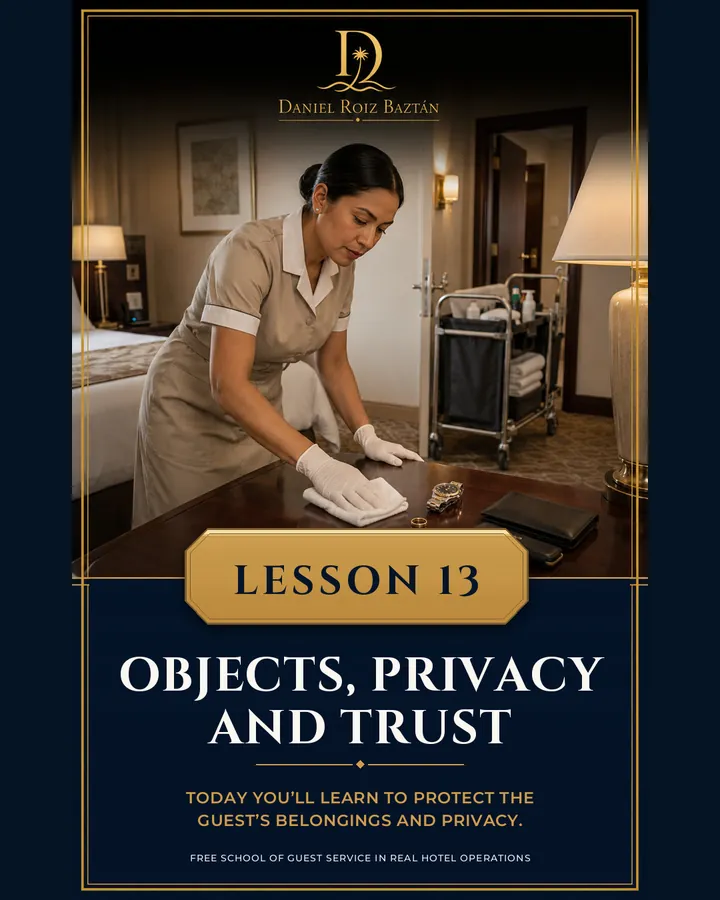
Housekeeping staff go where nobody else goes: into a stranger’s intimate space, with their belongings in plain sight and no witnesses. That privilege rests on two pillars that this lesson turns into protocol: the flawless handling of what the guest leaves — forgotten or in plain view — and absolute discretion about what you see. It isn’t just ethics: it is the protection of your career, because on this ground a single shadow weighs more than a thousand perfect rooms.
The script, step by step
- 1Their things are untouchable. In an occupied room you clean around their belongings: they are moved only as much as is essential and put back in their exact place. Tidying is fine; reorganizing their life is not.
- 2Money and valuables in plain sight, in an occupied room. You don’t touch them, you clean around them, and if the amount or the situation makes you uneasy (a lot of cash, loose jewelry), you tell the executive housekeeper that same shift: so there is a record that it was there — and that you reported it. The record protects you.
- 3An item left behind in a checkout room. It is logged immediately: what, where, room, date, time and who found it; it is handed to the executive housekeeper the same shift; if it is money or valuables, with a second witness for the count and the seal. The item travels with its paperwork, always.
- 4Discretion as a uniform. What you see inside — who was there, how they lived, what there was — doesn’t exist outside. Not to your colleague in the floor pantry, not to your family at home, and never on social media. The trust of a thousand guests who don’t know you rests on your silence.
With limited resources: how to hold the standard
In front of the guest
Treat their belongings as untouchable and their privacy as sacred. Put each thing back in its exact place.
Move belongings “to tidy up” more than necessary. Comment among colleagues on what there is or what you saw in a room.
Keep anything, however small or abandoned it may seem. Photograph the inside of a room. Tell outside what you saw inside — discretion has no day off.
Common mistakes
- The “I’ll hand it in later”: the time between finding and logging is exactly the time in which you become a suspect without having done anything.
- Logging without detail (“a bracelet”): a poor description turns the return into a dispute.
- Showing off guest anecdotes outside work: every story you tell teaches others what you would tell about them.
- Keeping quiet about what made you uneasy (too much money, a strange situation) to avoid complications: reporting it in time is your shield, not your problem.
“Honesty isn’t supervised: it’s who you are.
And a whole career can fit in the wrong pocket.”
Two scenes, two written answers: (a) loose money on the nightstand in an OCCUPIED room; (b) an envelope of cash left behind in a CHECKOUT room. Step by step, what you do in each one, with whom and what gets recorded. In the answer that follows, I share my version.
Objects, Privacy and Trust
Scene (a), occupied: the money is NOT touched — not even to “straighten it up.” You clean around it, leave it exactly where it is, and if the amount or the situation worries you, you tell the executive housekeeper that same shift so there’s a record: it was there, and you reported it. That record is your shield if tomorrow something is “missing.”
Scene (b), departure: it’s a valuable lost-and-found item — full, immediate protocol: you notify the executive housekeeper BEFORE moving anything, if possible; the count is done with a witness; it is recorded (room, date, time, amount, who found it, who received it), sealed and handed in that same shift. The envelope never waits in a pocket or on a cart “until I finish the floor”: the time between finding and recording is exactly the time in which you become a suspect without having done a thing.
And the part that wasn’t in the question: in neither scene is the find discussed in the floor pantry. Discretion applies inward too.